
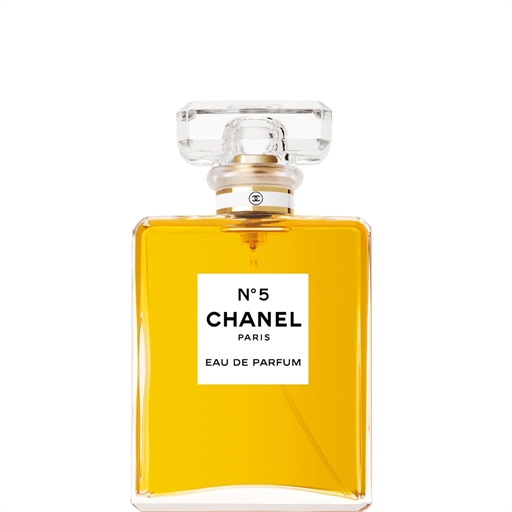
An abstract floral lifted by aldehydes, introduced in 1921. Chanel put her own name on it, and the result set the model for the designer fragrance.
At a glance
Chanel No. 5 is the Chanel perfume composed by Ernest Beaux and introduced in 1921. It is an aldehydic floral: a rich bouquet of rose and jasmine lifted by a heavy dose of aldehydes, so that it smells of no single flower.
It is also the fragrance that turned the couturier’s perfume into a worldwide success, a decade after Paul Poiret’s Parfums de Rosine (1911). A couturier put her own name on a bottle, and a century later it remains one of the best-known perfumes in the world.
Creation and context
Ernest Beaux trained and worked at A. Rallet & Co. in Moscow, the Russian perfume house, and became its senior perfumer. After the Revolution he continued his career in France, working for the Chiris company at La Bocca, near Cannes. Gabrielle Chanel approached him there in 1920.
Beaux worked on the composition through the late summer and autumn of 1920. He drew on the rose-and-jasmine structure of his earlier Rallet work, Rallet No. 1. He then presented Chanel with two numbered series of samples, one to five and twenty to twenty-four. She chose the fifth and kept the number. The best-known version of the story has her tying it to the fifth of May, the date she showed her collections, but that is her own account and should be read as such. She later launched No. 22 from the second series.
Accounts differ on the exact launch. Some date the first presentation to clients at rue Cambon to 5 May 1921. Others describe a small first run given to clients at Christmas 1921, with wider retail sale following in 1922. Galeries Lafayette is usually named as the first Paris retailer. In 1924 Parfums Chanel was incorporated with the Wertheimer brothers, who took the majority stake. That arrangement, and the disputes it produced, shaped the perfume’s commercial history for decades.
A familiar legend says the aldehyde level came from a laboratory mistake: a full-strength dose used where a ten per cent dilution was intended. The story is widely repeated but cannot be checked, and the overdose may equally have been deliberate. What is documented is the result. No. 5 made aldehydes conspicuous in a way few earlier perfumes had.
The composition
No. 5 is built as a bouquet rather than a portrait of a flower. The aldehydes make the opening effervescent and soapy, and they lend the florals a luminous, powdery lift that most people now simply recognise as “No. 5”. Chanel does not publish the formula; the structure below is the one the standard sources agree on.
The aldehydes are the aliphatic kind, which smell waxy, citrus-peel and faintly metallic on their own. In No. 5 they do not read as a separate note. They lift and diffuse the florals, and that is why the perfume smells abstract rather than botanical.
Why it matters
No. 5 matters on two counts. As a composition, it made aldehydes the signature of a family: the aldehydic floral runs from No. 5 through Lanvin’s Arpège (1927) and on for much of the century. It was also a second, decisive argument for the abstract perfume that Jicky had opened in 1889, a fragrance meant to smell of itself and not of a garden.
As a business, it made the couturier’s perfume a worldwide phenomenon. Chanel attached her name directly to a perfume sold as an extension of a fashion house, and the 1924 partnership with the Wertheimers became the template for the licensing model the industry still runs on.
Its cultural reach is unusual even among classics. Marilyn Monroe’s 1952 remark that she wore nothing to bed but a few drops of No. 5 is one of the most quoted lines ever attached to a perfume, and the squared bottle, simplified in 1924 from the rounder original of 1922, became a design icon in its own right.
Reformulation and editions
Treat these as different perfumes sharing a name, not stronger and weaker dilutions of one formula. Like every perfume of its age, No. 5 has been adjusted over the decades as materials and regulation changed. The house does not publish a history of those changes, so any claim about a specific reformulation should be treated with caution.
Wearing it today
Start with the parfum or the eau de toilette if you want the composition closest to Beaux’s. The eau de parfum is the one most counters carry, and it is warmer and sweeter. Expect a soapy, sparkling opening that settles within the hour into powdery florals over a soft woody-vanilla base; it is formal rather than casual, and a little goes a long way.
Comments
3 responses to “Chanel No. 5”
[…] Chanel No. 5 […]
[…] Chanel No. 5 […]
[…] Chanel No. 5 (childhood memories) […]