
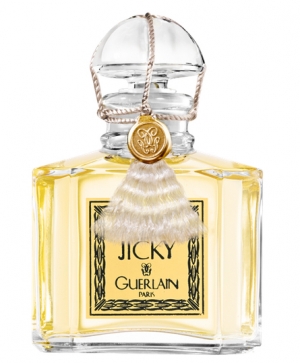
A lavender top over vanilla, coumarin and civet, launched in 1889 and still in production. It is usually called the first modern perfume.
At a glance
Jicky is a Guerlain perfume composed by Aimé Guerlain and launched in 1889. It sets lavender and bergamot over a warm base of vanilla, coumarin and civet, and it is conventionally called the first modern perfume.
It is also the oldest fragrance still in continuous production. That gives it a double status: a historical document you can still buy, though the bottle on sale today is not the 1889 formula.
Creation and context
Aimé Guerlain was the second-generation perfumer of the house, son of its founder Pierre-François-Pascal Guerlain. He composed Jicky inside a family firm where composition, manufacture and retail sat under one roof, so there was no outside client brief to satisfy. A composition with no obvious subject and no obvious market could survive in that setting.
The timing matters. Synthetic aromatics had only just reached perfumers: coumarin was first synthesised in 1868 and vanillin in 1874. Houbigant’s Fougère Royale had already built a perfume around coumarin in 1882, so Jicky was not the first fragrance to use a synthetic. What it did differently was treat the new materials as structural elements of an abstract composition, not as cheaper stand-ins for a natural.
The name has never been settled. The most common account says it was the nickname of Aimé’s nephew, the future perfumer Jacques Guerlain. A competing legend says it was the pet name of a young woman Aimé knew while studying in England. The house has not confirmed either, so treat both as tradition rather than record.
The early market did not quite know what to do with it. Most accounts agree that it took time to find its audience. The bottle, which the house says was modelled on a nineteenth-century apothecary jar, carries a stopper shaped like a champagne cork.
The composition
Jicky is built on a contrast between a fresh, aromatic top and a sweet, animalic base, and the gap between the two registers is the point. Guerlain has never published the formula, so what follows is the structure as documented in the standard secondary sources.
Lavender carries the top, and it is the lavender-coumarin pairing that places Jicky in the fougère family. The vanilla and civet push it toward what would later be called the oriental, which is why the modern classification is usually amber fougère.
Why it matters
Before Jicky, a perfume was expected to picture something: a flower, a bouquet, a refreshing cologne. Jicky pictures nothing. It is a composition in its own right, and every abstract perfume that followed descends from that decision.
Its base is just as consequential. The vanilla-coumarin-animalic accord is the direct ancestor of the Guerlinade, the signature base that runs through later Guerlain work, and of Shalimar. House legend says Jacques Guerlain made Shalimar by pouring ethyl vanillin into a bottle of Jicky. The story is almost certainly a simplification, but the lineage it points at is real, and the oriental family owes a large debt to Jicky’s base.
For the history of materials, Jicky is one of the clearest early demonstrations that a synthetic could be a compositional element with its own character. That argument is the foundation of twentieth-century perfumery, from the aldehydes of Chanel No. 5 onward.
Reformulation and editions
Jicky has been reformulated repeatedly over more than a century. The most noticeable change is the animalic base: natural civet has been replaced with synthetic civet materials, and the modern versions are widely described as cleaner and less animalic than vintage bottles. Regulatory limits on naturals and on some constituents have also constrained the formula, as they have for every perfume of its age.
It is sold today as an eau de toilette, an eau de parfum and an extrait (parfum), and an eau de cologne has also been produced. Reviewers generally find the concentrations noticeably different in balance, with the extrait the richest and the most animalic.
Wearing it today
Expect lavender and citrus first, then a long, powdery vanilla drydown with a faint animal edge; if you know Shalimar, you will recognise the family resemblance. It wears naturally on anyone. Try the extrait or the eau de parfum if you want the depth the history describes, and a vintage bottle only if you want the civet at full strength.
Comments
2 responses to “Guerlain Jicky: Lavender, Citrus & Vanilla Notes”
[…] Guerlain – Jicky […]
[…] Guerlain – Jicky […]