
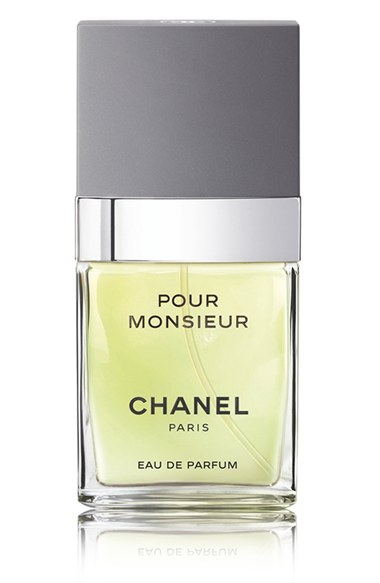
A restrained Chanel citrus chypre by Henri Robert, launched in 1955 and still in production.
At a glance
Pour Monsieur is a Chanel fragrance composed by Henri Robert and launched in 1955. It is a citrus chypre: lemon, petitgrain and neroli over a spiced heart and a dry base of oakmoss, vetiver and cedar.
It was launched during Gabrielle Chanel’s lifetime and is still in production, which makes it one of the longest-running fragrances in the Chanel line.
Creation and context
Henri Robert came to Chanel with a long career behind him. He had worked for Chiris, for Parfums d’Orsay, where he composed Le Dandy in 1923, and for Coty, where he became chief perfumer after François Coty’s death in 1934. He succeeded Ernest Beaux as Chanel’s perfumer in the early 1950s; Chanel dates the handover to 1954, while other accounts give 1952 or 1953. He held the post until 1978, and his later work for the house includes No 19 (1970) and Cristalle (1974).
His Coty years matter here. Coty had defined the chypre in 1917, and Robert had been chief perfumer at the house that owned the form. Pour Monsieur reads as a dry, tailored application of that structure by someone who knew it from the inside.
Pour Monsieur arrived a year after Gabrielle Chanel reopened her couture house in 1954. Chanel’s own history describes it as a fresh chypre with top notes of lemon, a spicy heart and a woody trail. That is an accurate summary: the composition is restrained, dry and closer to a tailored eau de cologne than to the heavier fragrances that followed in the 1970s.
The composition
Chanel has not published the formula. The structure below uses only the materials named in at least two of the standard references.
Some sources add bergamot, mandarin, basil, ginger, labdanum, patchouli and musk. Critics single out the moss: Persolaise describes the “inky, almost acrid bitterness of the mossy elements”, and that bitterness is what separates Pour Monsieur from a simple citrus cologne.
The skeleton is the one Coty’s Chypre established: citrus over moss. What Pour Monsieur removes is the sweetness and the animalic weight of the classic chypres, putting spice and dry woods in their place.
Why it matters
Pour Monsieur is the starting point of a Chanel lineage. Its successors, from Antaeus (1981) to Égoïste (1990) and Bleu de Chanel (2010), all arrived with Pour Monsieur already on the shelf beside them, and it remains the house’s reference for a formal, understated scent.
It is also one of the clearest surviving examples of the mid-century tailored chypre: citrus over moss, with no sweetness and very little projection. Pour Monsieur applied the construction of a French couture perfume to a dry, restrained scent, and it did so quietly enough to become a reference rather than a fashion.
For anyone studying the house it is a useful control. Sampled beside Antaeus and Égoïste, it shows how far Chanel’s idea of a tailored fragrance moved in thirty-five years: from citrus and moss, to leather and animalics, to sandalwood and spice.
Reformulation and editions
In the late 1980s Jacques Polge added Pour Monsieur Concentrée (dated 1988 in some sources and 1989 in others). Despite the name, it is a separate composition rather than a stronger version of the original: Now Smell This lists lavender, nutmeg and opoponax among its notes and calls it “simpler, sweeter” than its parent. A later eau de parfum also exists.
Oakmoss has been progressively restricted under IFRA standards since 2008, and the fragrances that depend on it have been adjusted to comply. Chanel has not published the details for Pour Monsieur, so expect current bottles to differ from vintage ones, most noticeably in the moss.
Wearing it today
Expect a crisp lemon-and-neroli opening, a brief warm spice, then a dry, mossy, slightly soapy finish that stays close to the skin. It suits office wear and warm weather. If you want the original, check the label: Concentrée and the eau de parfum are different fragrances.
Apply it as you would a cologne, two or three sprays at the neck or chest. Because the base is dry rather than sweet, it sits badly under amber or gourmand layers and works best on its own.