
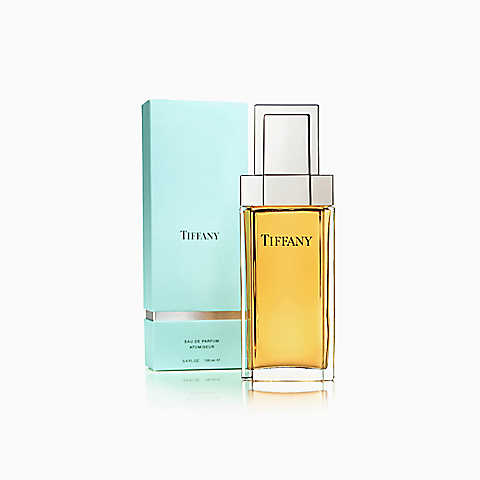
The jeweller’s first fragrance: a rich blackcurrant, rose and amber floral by François Demachy, launched in 1987 and since discontinued.
At a glance
Tiffany is the first fragrance named for the New York jeweller Tiffany & Co., launched in 1987 and composed by François Demachy. It is a rich floral: blackcurrant and mandarin open onto a bouquet of Taif rose, orange blossom and lily of the valley, over sandalwood, vetiver and amber.
The original has been discontinued. It is now sought after on the vintage market, and it is distinct from the Tiffany & Co. fragrances launched under licence from 2017.
Creation and context
Tiffany & Co., founded in New York in 1837, had built its name on jewellery, silver and its blue boxes rather than on perfume, and the 1987 launch was the first fragrance to carry that name. Fragrantica describes Tiffany as the work of “the young perfumer François Demachy”, and Wikipedia lists it among his works. Demachy trained at Charabot in Grasse and then joined Chanel, where he spent most of his early career before becoming Dior’s in-house perfumer. Two years later, according to Fragrantica, Chanel’s Jacques Polge composed Tiffany for Men (1989).
That pairing of Chanel perfumers is why collectors and reviewers often describe the early Tiffany fragrances as Chanel-made. Tiffany has not published the arrangement, so treat it as a plausible reading of the credits rather than a documented licence.
The launch fits the late 1980s taste for grand, full-bodied florals, and the presentation was meant to match the jeweller’s image. Fragrantica credits the bottle to Pierre Dinand and records a FiFi award for it in 1988.
The composition
The formula has not been published. The structure below uses only the materials named in at least two of the references.
Fragrantica also lists ylang-ylang, iris, jasmine, violet leaf and vanilla, which fit the character but are not confirmed elsewhere. What the references agree on is the effect: an orchestral, polished floral with no rough edges. The blackcurrant gives the opening a bite that keeps the bouquet from turning heavy, and the amber and sandalwood give it the depth and staying power that reviewers still praise in vintage bottles.
Why it matters
Tiffany is an early example of a jeweller using fragrance to extend its brand. Cartier had moved into perfume earlier in the decade, and Bvlgari followed with its first fragrance in 1992; both went on to build far larger fragrance businesses than Tiffany did. It also shows a luxury name relying on established perfumers rather than building a perfume house of its own.
For perfumery history, it is an early work by François Demachy, who later spent many years as Dior’s in-house perfumer. It is also a good example of the late-1980s luxury floral: fuller and more ornate than the transparent florals that followed in the 1990s.
Reformulation and editions
Tiffany was issued in several concentrations; Fragrantica lists a separate Parfum alongside the eau de toilette and eau de parfum. Reviewers distinguish an original formula from later bottles, and one long-time wearer reported to Now Smell This that the eau de parfum had been discontinued by 2017.
In 2017 Tiffany began a new fragrance partnership with Coty. The resulting Tiffany & Co. eau de parfum, by Daniela Andrier, centres on iris and was described at launch as the brand’s first new fragrance in fifteen years. It is a different composition, not a reissue of the 1987 Tiffany.
Wearing it today
Expect a fruity blackcurrant opening, a rich, smooth rose-and-white-flower heart and a warm, woody amber drydown with good longevity. It suits evenings and cooler weather, and one or two sprays are enough.
Because the original is discontinued, you will be buying vintage. Check the colour and top notes of any bottle before buying, and expect prices for early bottles to be high. Once you have one, store it away from heat and light: vintage florals of this kind lose their bright top notes first.
Comments
2 responses to “Tiffany: A Rich, Complex Floral”
[…] Tiffany […]
[…] Tiffany […]