
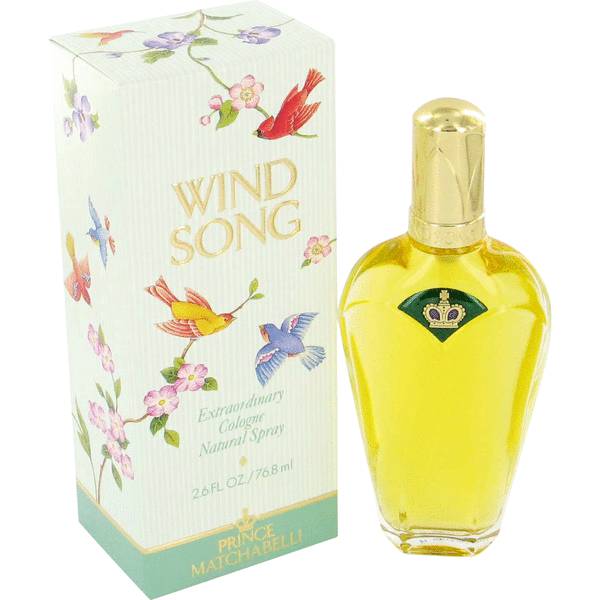
Prince Matchabelli’s spicy aldehydic floral from 1953, by Ernest Shiftan and Léon Hardy, and the fragrance that stayed on America’s mind.
At a glance
Wind Song is a Prince Matchabelli fragrance from 1953, credited to Ernest Shiftan and Léon Hardy. It is a spicy floral: an aldehydic citrus-and-herb opening, a heart of carnation, clove, orris, jasmine and rose, and a soft base of sandalwood, amber, musk and benzoin.
It was one of the best-known American mass-market fragrances of the post-war decades, helped by a famous advertising jingle, and it is still sold today in a much-changed, inexpensive form.
Creation and context
Prince Matchabelli was founded in New York in 1926 by Prince Georges V. Matchabelli, a Georgian aristocrat, and his wife Norina. Its signature was a crown-shaped bottle designed by Norina after the family crown and introduced in 1928, with the glass colour-coded by fragrance. The founders did not own the company for long: it was sold to the perfume manufacturer Saul Ganz in 1936 and to the Vick Chemical Company in 1941, so Wind Song was launched under Vick ownership.
Cafleurebon and Now Smell This both credit the fragrance to Ernest Shiftan and Léon Hardy; Cafleurebon places Shiftan at IFF. Fragrantica and Cafleurebon date the launch to 1953, while Now Smell This gives 1952, so the release may have straddled the two years.
Wind Song became a household name through advertising. Its jingle, “I can’t seem to forget you, your Wind Song stays on my mind,” is quoted by both Now Smell This and Cafleurebon, and it kept the name familiar to American audiences for decades.
The composition
The formula has not been published. The structure below uses only the materials named in at least two of the references.
The carnation-and-clove heart is the key to its character. Clove’s eugenol gives carnation its spice, and the pairing sits under a burst of aldehydes and citrus in the manner of the great aldehydic florals, but at a mass-market price. Cafleurebon warns that the aldehydes can seem overwhelming at first and reward patience; reviewers on Fragrantica more often describe the result as clean and fresh, like good soap.
Fragrantica specifies Brazilian rosewood, an oil that has become much harder to use since the 1950s: the rosewood tree is now listed under CITES, which restricts its international trade. It is one more reason a modern version cannot simply copy the original.
Why it matters
Wind Song belongs to the same moment as Estée Lauder’s Youth-Dew (1953), when American companies were building fragrance into an everyday purchase rather than a luxury import. It is an example of the aldehydic, spicy floral style, established by French houses, sold at American mass-market prices.
It is also a case study in how a fragrance brand passes from owner to owner. Vick sold Prince Matchabelli to Chesebrough-Pond’s in 1958; Unilever acquired Chesebrough-Pond’s in 1987; and in 1993 Unilever sold the Prince Matchabelli brands to Parfums de Coeur.
Reformulation and editions
Wind Song has been substantially reformulated over the decades, and Cafleurebon ties the changes to its many ownership transfers. Current versions are produced by Parfums de Coeur and sold as a cologne spray and dusting powder at low prices through mass retailers.
Fragrantica reviewers note that vintage bottles, particularly those in the frosted crown flacon, have more depth and complexity than the modern formula. The name, the crown and the basic carnation-and-aldehyde idea survive; the richness of the original largely does not.
Wearing it today
Expect a bright, soapy aldehydic opening, a spicy carnation-and-clove heart and a soft, powdery, woody drydown. The modern cologne is light and inexpensive; vintage perfume is richer and lasts longer.
If you want to understand the original, look for older bottles in the crown flacon and check the top notes, since aldehydes are the first thing to fade. The current version is an easy, clean everyday scent, and Now Smell This suggests it for scenting linens and drawers as well as skin.
Comments
2 responses to “Prince Matchabelli Wind Song: An Enduring Classic”
[…] Wind song […]
[…] Wind song […]