
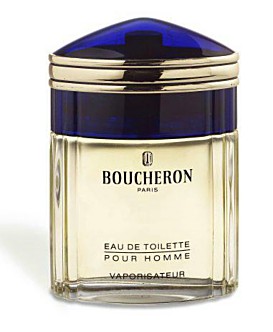
The jeweller’s classic citrus aromatic: lemon, basil and lavender over a soapy floral heart and a mossy, resinous base.
At a glance
Boucheron Pour Homme is the Paris jeweller’s classic fragrance, launched in 1991 according to Fragrantica and The Scented Devil (Parfumo dates it to 1989). It is a dense citrus aromatic in the old chypre manner: lemon, basil and lavender over a soapy floral heart, on oakmoss, vetiver, sandalwood and resins.
Raymond Chaillan is credited by Fragrantica, Parfumo and The Scented Devil; Fragrantica adds Francis Deleamont and Jean-Pierre Béthouart.
Creation and context
The launch date is recorded two ways. Fragrantica and The Scented Devil give 1991; Parfumo files the original eau de toilette and eau de parfum as the “1989 version”. Vintage bottles are sold under both dates, so treat the launch as falling between 1989 and 1991.
Chaillan’s name is the one common to every credit. The Scented Devil places the fragrance at the end of a career spent on dry, citrus-led compositions, including Yves Saint Laurent Pour Homme (1971), and describes Boucheron Pour Homme as his last documented work in that style. Fragrantica lists Francis Deleamont and Jean-Pierre Béthouart alongside him; they are not named by the other two sources.
Parfumo credits the bottle design to Alain Boucheron with Joël Desgrippes. Parfumo also lists an aftershave lotion in the same line, the usual companion product for a fragrance of this style in the period.
The composition
Boucheron has not published the formula. Fragrantica and Parfumo list almost the same long pyramid; the materials below appear in both.
Fragrantica classifies it as a citrus aromatic; Parfumo’s community rates the eau de toilette spicy-citrusy with a chypre accord, and The Scented Devil calls it a chypre outright. That overlap is typical of citrus aromatics of the period, where lemon, herbs and oakmoss sit between the two families.
Why it matters
Boucheron Pour Homme arrived as mainstream perfumery was abandoning the heavy “powerhouse” style of the 1980s for fresher, lighter scents. Instead of following the new aquatics, it went back further, to the lemon-and-moss compositions of the 1950s to 1970s. The Scented Devil compares it with Chanel’s Pour Monsieur (1955) and Monsieur de Givenchy.
The Scented Devil also points out that it was offered as an eau de parfum from the start, at a time when most stronger versions in this style were sold as “eau de toilette concentrée” to avoid the word parfum.
Within Boucheron’s own range it is the counterweight to Jaïpur Homme (1998), a warm spiced oriental. Together they cover two main directions of classic perfumery: fresh citrus-and-moss and warm spice.
Reformulation and editions
The original came as eau de toilette and eau de parfum. After the Boucheron licence moved to Interparfums in 2011, Parfumo lists a new Boucheron pour Homme eau de toilette dated 2011, with a much shorter pyramid of verbena, bergamot, coriander, basil, patchouli and sandalwood, marketed by Interparfums. Parfumo credits no perfumer for it.
The eau de parfum is still sold: LATF USA’s 2022 feature on the Interparfums eau de parfum gives the same long pyramid and the three-perfumer credit found on Fragrantica. Boucheron has not published a reformulation history, but like every oakmoss-based classic it is subject to IFRA limits on that material.
Wearing it today
Expect a sharp lemon and basil opening, a soapy carnation and orris heart, and a mossy, resinous drydown. The Scented Devil finds the eau de toilette drier and the eau de parfum sweeter and heavier in the base.
It suits the office and formal wear in any season except high summer. The Scented Devil and Parfumo users both rate it as good value for money.
Comments
One response to “Boucheron Pour Homme Fragrance Profile”
[…] Boucheron […]