
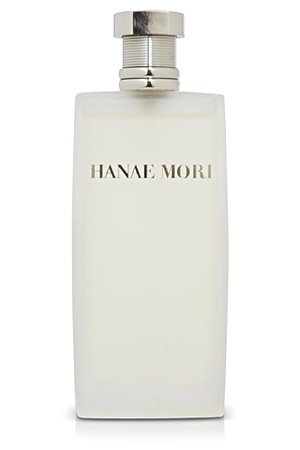
Hanae Mori’s late-1990s fragrance: lemon and lavender over vanilla, tonka and chocolate.
At a glance
HM is a fragrance from the Japanese couture house Hanae Mori, dated 1997 by Fragrantica and 1998 by Parfumo. It is one of the more unusual fragrances of the late 1990s: bright lemon and lavender over a floral heart, settling into vanilla, tonka bean and a note of chocolate.
No perfumer has been credited publicly. HM is sold as both an eau de toilette and an eau de parfum, and both are still in production.
Creation and context
Hanae Mori (1926–2022) opened her Paris studio in 1977, the year she became a member of the Chambre Syndicale de la Haute Couture, and was known for blending Japanese and Western dress and for her signature butterfly motifs. Her business grew beyond clothing into perfume, handbags and publishing; W magazine’s obituary noted that her fragrances remained shelf staples long after she stopped showing couture in Paris in 2004.
HM arrived in the late 1990s, when most new launches were fresh, aquatic or citrus. It went the other way. Fragrantica describes it as an oriental woody fragrance with a gourmand touch of chocolate, and The Perfume Critic, reviewing it in 2006, called it one of the most unusual releases of the decade and “a one-of-a-kind gourmand oriental”.
Fragrantica’s own editorial review lists the perfumer as unknown, and neither Parfumo nor Fragrantica credits a nose. Treat any name you see attached to HM with caution.
The composition
The structure below uses the notes that appear in at least two published pyramids (Fragrantica, Parfumo and The Perfume Critic). Parfumo’s list is shorter; Fragrantica’s is the fullest.
The logic is a fougère turned sweet. Lemon and lavender over tonka is the classic barbershop skeleton; HM adds a white-floral heart and then pushes the base toward dessert with vanilla and chocolate. Fragrantica’s editorial review calls it “a unique gourmand fougere”, which is a fair summary of the effect.
Why it matters
HM belongs to the first wave of gourmands. The gourmand family began with Thierry Mugler’s Angel in 1992, and its companion, A*Men, followed in 1996. HM took a different route to sweetness: instead of Angel’s caramelised ethyl maltol and patchouli, it built on the traditional lavender-and-tonka frame and added vanilla and cocoa.
It was also early to the chocolate note. The Perfume Critic noted that HM was pairing iris and chocolate long before Dior Homme made that combination familiar to fragrance buyers.
For a couture house better known for dresses and silk than for perfume, HM became a long-running success. It has stayed in production for more than twenty-five years, in both concentrations.
Reformulation and editions
HM exists as an eau de toilette and an eau de parfum, both listed by Parfumo and both still produced. Fragrantica’s editorial review describes the tall, frosted glass bottle with a silver cap, and says the two concentrations can be told apart by their boxes: striped for the eau de parfum, solid for the eau de toilette. The Perfume Critic also mentions an Eau Fraîche version, slightly less sweet than the original.
Hanae Mori’s follow-up, HiM (2012), is a separate composition: spicy and woody rather than gourmand. No reformulation of HM has been documented, though, as with any fragrance sold for decades, older and newer bottles may differ.
Wearing it today
Expect a tart lemon-and-lavender opening, a sweet jasmine heart and a long vanilla, tonka and cocoa drydown. It is distinctly sweet, so it suits cooler weather and evenings better than summer days, and one or two sprays are enough. The eau de parfum is the richer of the two; start with the eau de toilette if you are unsure about the sweetness.
HM has long sold at low prices (both Fragrantica and The Perfume Critic found 100 ml for around $22–24), which makes it an inexpensive way to try an early gourmand.