
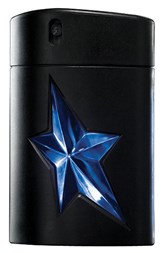
Thierry Mugler’s darker answer to Angel: coffee, patchouli and tar in an early roasted gourmand, launched in 1996.
At a glance
A*Men is a Thierry Mugler fragrance composed by Jacques Huclier and launched in 1996. It is a woody gourmand: lavender and mint over patchouli, caramel and roasted coffee, with a tarry, vanillic base.
It was conceived as the counterpart to Angel (1992), and it is one of the earliest followers of Angel built openly on sweet, edible notes. It has also been sold as Angel Men.
Creation and context
Angel had shown that a perfume built on patchouli and a candy-sweet accord could sell in volume. The obvious next step was a companion version, and Mugler, whose fragrances were developed with the Clarins group, gave the brief to Jacques Huclier. A*Men was introduced in Europe in September 1996 and reached the United States in spring 1997, which is why some references give 1997.
The market it entered was dominated by fresh, transparent fragrances: citrus, aquatic and clean woody compositions. A*Men went the other way. It kept Angel’s patchouli-and-sweetness structure but moved it toward coffee, tar and aromatic herbs, so that the sweetness reads as roasted and smoky rather than sugary.
Thierry Mugler designed the bottle himself, a flask shape in metal or in matte black rubber, carrying the house’s star. The Fragrance Foundation named it men’s fragrance of the year in the luxury category in 1998.
The composition
Mugler has not published the formula. The structure below keeps to the materials named in at least two of the standard references.
Some sources add chocolate, milk, amber and sandalwood. The tar is the note that divides wearers. It gives the drydown a smoky, slightly industrial edge that keeps the caramel and coffee from turning into confectionery, and it is the element reviewers most often say has been softened in later bottles.
Why it matters
A*Men is the proof that the gourmand was not a one-off. Angel created the category in 1992; A*Men carried it further four years later and showed that sweetness could be made to read as dark and dry by pairing it with patchouli, coffee and tar.
Its influence is visible in the sweet, dark fragrances of the following decades, many of which borrow the same combination of lavender or herbs over vanilla, tonka and roasted notes. At the time, it was an outlier. Now Smell This’s 2008 review called it the ugliest-smelling scent the reviewer had ever worn, and the fragrance has kept that capacity to polarize. The same review noted that Saks Fifth Avenue stocked it in more than one department, a sign that it was aimed at Angel’s wearers as well.
It also shows how Mugler worked as a house: one strong idea, pushed further than its competitors would risk, and then developed through flankers rather than replaced.
Reformulation and editions
A*Men has been extended through a long series of flankers built on the same structure. The best documented are A*Men Pure Coffee (2008), Pure Malt (2009) and Pure Havane (2011), each pushing one facet of the original, from roasted coffee to whisky to tobacco and honey.
Reviewers on Basenotes and Parfumo report that the current version is lighter than early bottles, with less tar and shorter longevity. Mugler has not published details of any reformulation, and the house passed to L’Oréal in 2020, so expect variation between vintage and current stock.
Wearing it today
Expect a sharp, minty lavender opening, then coffee and caramel over patchouli, and a long, smoky vanilla drydown. It is dense and it projects: one or two sprays are enough, and it suits cold weather and evenings better than a warm office.
If you enjoy Angel but want something drier, A*Men is the natural comparison. If you find it too sweet, try Pure Havane, which trades some of the caramel for tobacco.
Comments
One response to “Thierry Mugler A*Men: The Fragrance That Started a Trend”
[…] Thierry Mugler – A*Men […]