
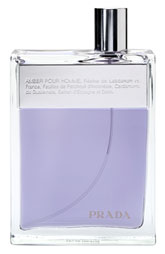
Prada’s clean, soapy oriental fougère by Daniela Andrier: the companion to the 2004 Prada Amber.
At a glance
Prada Amber Pour Homme, also sold as Prada Man, is the companion to Prada’s first broadly distributed fragrance. It was composed by Daniela Andrier and is usually dated to 2006. It is an amber fougère: citrus and cardamom over an orange-blossom and myrrh heart, with a soft base of labdanum, vanilla, saffron and suede.
It is best known for a clean, soapy elegance that reviewers compare to expensive hotel soap, and for a quiet, understated character.
Creation and context
The name needs explaining. Prada’s first fragrance for a wide audience was an eau de parfum launched in 2004, composed by Carlos Benaïm, Max Gavarry and Clément Gavarry. It was sold simply as Prada, and it became known as Prada Amber after the word on its metal plaque. Its four main materials, according to Fragrantica, were sandalwood, patchouli, labdanum and benzoin.
Amber Pour Homme followed. Fragrantica and Now Smell This date it to 2006, and Now Smell This reviewed it as a new launch in August of that year; Basenotes lists it under 2004, the year of the original, which is probably why the two dates are often confused. All three credit Daniela Andrier.
The two share a name and an amber theme but not a formula. Now Smell This notes that Pour Homme replaces much of the original’s warmth with a fresh cologne accord and a suede note, and the Chemist in the Bottle blog calls it a “distant relative” of the original.
The composition
Prada has not published the formula. The structure below uses only the materials named in at least two of the references (Fragrantica, Now Smell This and Basenotes).
Fragrantica describes four accords working together: an amber-and-vanilla oriental base, a soapy fougère, a fresh citrus top and a soft leather. The soap is the signature. Basenotes reviewers compare it to hand soap from a very expensive European hotel, and one notes that the effect comes from floral notes undercut with creamy textures and a touch of bitterness rather than from anything that smells like detergent.
Why it matters
Amber Pour Homme is one of the best-known clean, soapy fragrances of the 2000s. Where many launches of the decade competed on freshness or sweetness, it offered restraint: a fragrance that reads as well-groomed rather than as perfume. Now Smell This called it “elegant and sophisticated in a very quiet way”, with a conservative, even sober quality.
It also shows how Prada approached fragrance under its own name. The 2004 Amber and the 2006 Pour Homme are both refined, low-key compositions built on classic materials such as labdanum, myrrh and orange blossom rather than on novelty.
Reformulation and editions
The original is an eau de toilette; at launch Now Smell This listed 50 ml and 100 ml sizes and a deluxe 100 ml atomiser. Prada Amber Pour Homme Intense followed in 2011, according to Fragrantica, as a darker and spicier variation. Prada has not published a reformulation history for either.
Because the 2004 Prada is also sold as Amber, check the label before you buy or compare reviews: “Prada Amber” on its own usually means the 2004 eau de parfum, not this fragrance.
Wearing it today
Expect a clean citrus-and-cardamom opening, a soapy orange-blossom heart and a soft, warm drydown of amber and suede. Projection is moderate and it lasts well, which makes it an easy office and daytime fragrance in any season.
Reviewers often say it took them time to appreciate it, so wear it for a full day before you decide. It is easy for anyone to wear, as Now Smell This pointed out when it first appeared. If you already know a traditional fougère, compare the two: the barbershop lavender is replaced here by soap, citrus and resin, a more polished take on the same idea of cleanliness.