
Jasmine over an unusually generous dose of Mysore sandalwood, launched in 1989. It is the last great Guerlain classic composed within the family.
At a glance
Samsara is a Guerlain perfume launched in 1989 and composed by Jean-Paul Guerlain with Anne-Marie Saget. It is built on an accord of jasmine and sandalwood, with an unusually large dose of Mysore sandalwood in the original formula, and it is usually classed as a woody oriental.
It was the last major Guerlain classic composed by a member of the family before the house was sold to LVMH in 1994, and for many wearers it remains the reference sandalwood perfume.
Creation and context
Jean-Paul Guerlain, grandson of Jacques Guerlain, had been composing for the house since the late 1950s. Samsara became his biggest late success: its launch is widely credited with re-establishing the house among the major French perfume names.
Jean-Paul Guerlain composed it with Anne-Marie Saget, who worked on the house’s fragrances at its Chartres factory and is named as co-author by Wikipedia and Fragrantica. Saget left Guerlain in 1989, shortly after the launch. Some listings still credit Jean-Paul Guerlain alone.
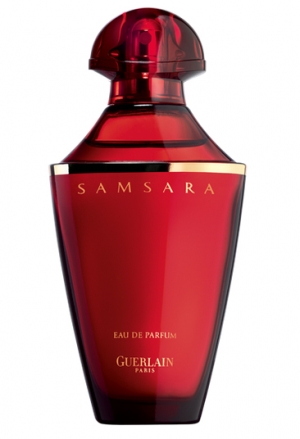
The name is the Sanskrit word for the cycle of birth, death and rebirth in Hindu and other South Asian religious traditions. It was released during the late-1980s vogue for meditation and yoga, and it was pitched as a calm, meditative fragrance rather than a seductive one. The original bottle was a deep red, a colour now closely associated with the vintage formula.
The composition
The core of Samsara is simple to state: jasmine and sandalwood, with a creamy, sweet base underneath. What made it unusual was the proportion. Accounts of the original formula agree that it used far more natural Mysore sandalwood than was normal, with published estimates ranging from about 20 percent to as much as 30 to 40 percent. The natural wood was lifted with Polysantol, a then-recent synthetic sandalwood material, to make it more diffusive.
The jasmine and ylang-ylang carry the floral side, but the wood is always present, so Samsara reads less as a sequence of top, heart and base than as one warm accord that holds for hours. The vanilla and tonka connect it to the older Guerlain orientals, while the sandalwood gives it a drier, woodier character than Shalimar.
Why it matters
Samsara is widely treated as the high point of sandalwood in modern commercial perfumery. It was composed while good Mysore oil was still obtainable in quantity, and it used that material at a strength that would be very hard to repeat now. For collectors and perfumers it remains the benchmark against which other sandalwood fragrances are judged.
It is also a bookend. Guerlain’s great family period runs from Aimé Guerlain’s Jicky in 1889 through Jacques Guerlain’s Shalimar to Jean-Paul Guerlain’s Habit Rouge and Samsara. Five years after Samsara the house was sold to LVMH and began working with outside perfumers, so Samsara is usually counted as the last classically styled Guerlain perfume made within the family.
Finally, it is a case study in what happens when a key natural becomes unavailable. The story of Samsara’s reformulation is, in large part, the story of Mysore sandalwood itself.
Reformulation and editions
Indian sandalwood was over-harvested through the twentieth century, and from the 1990s the Indian government tightened controls on the trade. Guerlain reformulated Samsara using other sandalwood sources and synthetic sandalwood materials. Reviewers who compare the two describe the modern version as sharper and brighter, with more obvious vanilla, and the vintage as creamier and rounder. Fragrantica also attributes a more recent revision to regulatory limits on Polysantol, the synthetic that supported the original.
Samsara has been sold as an eau de toilette, an eau de parfum and a parfum (extrait), and the bottle has changed more than once since the original red design. Vintage bottles, especially early ones, are sought after for the natural sandalwood.
Wearing it today
Expect a brief citrus lift, then jasmine and ylang-ylang settling quickly onto a creamy sandalwood-and-vanilla base that lasts a long time and projects well. It is dense and warm, so apply lightly. If you want to understand what the fuss about Mysore sandalwood was, look for a vintage bottle, and compare it with Shalimar to hear how differently the two Guerlain orientals handle warmth.
Comments
One response to “Guerlain Samsara: Sandalwood, Jasmine & Amber Notes”
[…] Samsara […]