
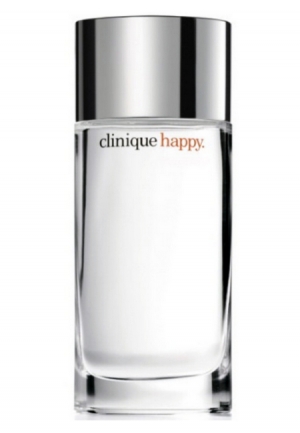
Clinique’s bright citrus fruity floral of 1997 by Rodrigo Flores-Roux and Jean-Claude Delville, and the house’s best-selling fragrance.
At a glance
Happy is a Clinique fragrance composed by Rodrigo Flores-Roux and Jean-Claude Delville and launched in 1997. It is a bright, fresh fruity floral: citrus at the top, including bergamot, mandarin and grapefruit, over a transparent floral heart and a soft base of magnolia, mimosa and lily.
It won the FiFi Award for Women’s Fragrance of the Year in 1998 and became Clinique’s best-selling fragrance. Clinique is part of the Estée Lauder group.
Creation and context
Clinique launched in 1968 as an allergy-tested skincare line within Estée Lauder, and its first fragrance, Aromatics Elixir, followed in 1971. Happy arrived a quarter-century later as a light, bright scent for everyday wear; Fragrantica’s description sums up the brief in a line: “Wear Happy and be happy!”
Wikipedia’s Clinique article, CaFleureBon and Now Smell This’s perfumer directory all date it to 1997; Fragrantica lists 1998, the year of its FiFi award. CaFleureBon, Fragrantica and Now Smell This credit the composition to Rodrigo Flores-Roux and Jean-Claude Delville. Delville went on to co-write the first Vera Wang fragrance (2002) with Harry Frémont.
The launch was supported by a long-running print campaign. CaFleureBon reports seventeen advertisements in all, photographed by Steven Meisel, with the model Karen Elson in 1997 and Kylie Bax in 1998.
The composition
Clinique has not published the formula, and the two main note lists differ in their wording. The structure below uses only the materials named in both Fragrantica and CaFleureBon.
Fragrantica’s list also names apple, plum, freesia, rose, musk and amber, and its description speaks of a “fresh-air accord”; the earlier version of this post followed that list. CaFleureBon gives more fanciful names, such as boysenberry blossom and Hawaiian wedding flower, which read as marketing descriptions of accords rather than raw materials.
The key to its brightness is a single molecule. In CaFleureBon, Flores-Roux describes Happy as one of the first overdoses of the cis isomer of methyl dihydrojasmonate, the molecule sold as Hedione, bringing an “opalescent, luminous transparency” to the centre of the composition. That helps explain the airy, radiant quality of the heart.
Why it matters
Happy matters for two documented reasons. The first is technical: by its perfumer’s account it was built on an early overdose of cis-Hedione, the high-cis grade of a material that adds air and diffusion rather than a note of its own. The second is commercial: a transparent citrus floral became the best-selling fragrance of a major beauty brand.
Its standing has lasted. Wikipedia’s list of FiFi winners records its 1998 Women’s Fragrance of the Year (Prestige) award, which CaFleureBon also cites, and adds that Happy entered the FiFi Hall of Fame in 2014. Both Wikipedia and CaFleureBon describe it as Clinique’s best-selling fragrance.
Reformulation and editions
Happy is sold today as an eau de parfum. Clinique has built a family around it, including Happy for Men and flankers such as Happy Heart, each with its own Basenotes listing.
Clinique has not published a reformulation history, and no IFRA change specific to Happy is documented. If you remember the 1990s version, compare it with a current tester before buying. When you shop, check the name carefully: the flankers add a word to the name, such as Happy Heart, while the original is simply called Happy.
Wearing it today
Expect a burst of sparkling citrus, a clear, airy floral heart and a soft, clean finish. It is a daytime fragrance for spring and summer, easy for the office, and light enough to reapply.
Spray it on skin rather than clothing to let the citrus open properly. The top notes are the most fleeting part, so a light reapplication at midday brings back the sparkle; the floral heart and the soft base stay close to the skin for longer. If you like it, the clearest contrast in the same house is Aromatics Elixir: two Clinique fragrances a generation apart, the 1971 original and the 1997 best-seller.
Comments
One response to “Happy: Apple, Plum & Fresh Floral Fragrance Notes”
[…] Happy […]