
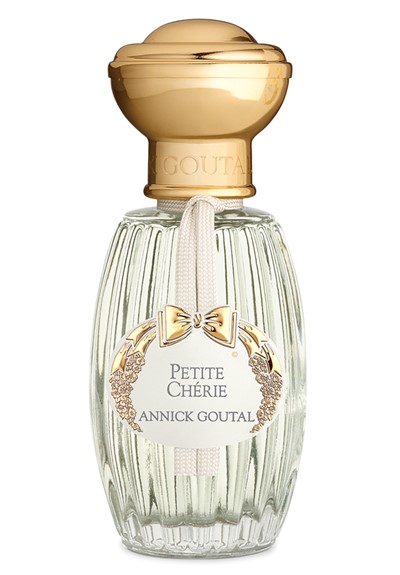
Annick Goutal’s 1998 portrait of her daughter: pear, peach and cut grass over musky rose and vanilla.
At a glance
Petite Chérie is a 1998 fruity floral from Annick Goutal: pear, peach and cut grass over a musky rose, with musk and vanilla underneath.
Annick Goutal made it for her daughter Camille, and CaFleureBon calls it one of the house’s iconic fragrances. It is soft, green-edged and light rather than sugary: an orchard more than a sweet shop.
Creation and context
Fragrantica, Parfumo and Now Smell This all date Petite Chérie to 1998, the year before Annick Goutal’s death in 1999. The name means “little darling”. In a CaFleureBon interview, Camille Goutal agreed with the interviewer that the fragrance was her mother’s tribute to her, and she described love as the thread that runs through the house’s work. The beauty blog Plusizekitten tells the same story and quotes Annick Goutal’s description of the scent as “reminiscent of a young girl’s cheek that you want to lovingly kiss.”
It was not Annick Goutal’s first perfume for her daughter: Plusizekitten notes that Eau de Camille came earlier, and Now Smell This dates Eau de Camille to 1983. Camille later returned the gesture with Mon Parfum Chéri, par Camille (2011), which CaFleureBon describes as a tribute to her mother.
The credit is not settled. Fragrantica names Annick Goutal alone. Parfumo credits Annick Goutal and Isabelle Doyen, the perfumer who had worked with the house since 1985, according to The Perfume Society. Treat Petite Chérie as Annick Goutal’s, with Doyen’s part as Parfumo’s attribution.
The composition
Goutal has not published the formula. The structure below uses only the materials that Fragrantica and Parfumo both list.
Fragrantica adds lilac and Hedione to the heart. Its description, taken from the house, reads the whole as fruit “covered with a ripple of peach and pear”, rose musk, a vanilla frame and “the powdery scent of refreshing cut grass.” The grass is what gives Petite Chérie its character. Without it the composition would be a pleasant pear-and-rose skin scent; with it, the opening smells of an orchard rather than a sweet shop.
Why it matters
Petite Chérie shows the restrained, independent-house version of the fruity floral: real fruit notes, a green counterweight and a light musk base, with no candy accord. Its survival for more than a quarter of a century, in several formats, makes it a useful reference when you are trying to tell a well-built fruity floral from a formulaic one.
It also belongs to the story of Annick Goutal as a pre-niche house. The Perfume Society describes Goutal’s personal fragrances as helping to change the industry “before ‘niche’ was a description on anyone’s lips.” Petite Chérie, a portrait of a family relationship sold as a perfume, is a clear example of that approach.
Reformulation and editions
Parfumo lists the original eau de parfum alongside an eau de toilette, an alcohol-free eau, a solid perfume and a hair mist. It also lists a limited Petite Chérie Édition Claudie Pierlot, a collaboration with the French fashion label that The Perfume Society also covered.
The house has changed since 1998. Now Smell This records that Annick Goutal was sold to Amorepacific in 2011 and renamed Goutal Paris in 2018, with updated packaging and a number of discontinued fragrances. Petite Chérie remained in the line: Parfumo lists it as marketed by Amorepacific, and retailers still stock the eau de parfum. No reformulation history has been published, so if you compare an older bottle with a new one, judge them by nose rather than by label.
Wearing it today
Expect a bright pear-and-grass opening, a soft rose heart and a clean musk-vanilla finish. Parfumo users rate its longevity as moderate, so it suits daytime, spring and summer, and it rarely overwhelms a room.
Apply generously to skin and a little to clothing if you want it to last. If you find modern fruity florals too sweet, this is a good one to sample first.
Comments
One response to “Annick Goutal Petite Chérie Fragrance Profile”
[…] Petite Cherie […]