
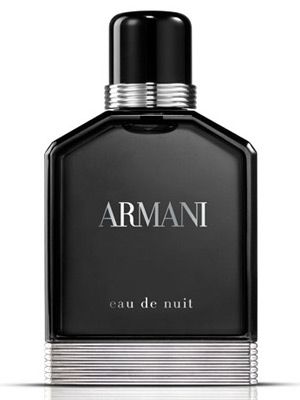
Giorgio Armani’s 2013 evening companion to Eau pour Homme: cardamom, iris and tonka bean in a black version of the 1984 bottle.
At a glance
Armani Eau de Nuit is a Giorgio Armani eau de toilette, launched in 2013 and credited to Marie Salamagne. It is a warm, spicy woody fragrance: bergamot and pink pepper over cardamom, nutmeg, iris and heliotrope, on a base of cedar, tonka bean and amber.
Armani introduced it as the evening counterpart to Armani Eau pour Homme, the house’s 1984 classic, which was reissued at the same time.
Creation and context
Now Smell This reported on 10 January 2013 that Giorgio Armani would relaunch Eau pour Homme, “reportedly unchanged”, and introduce “a warmer, more sensual variation, Eau de Nuit”. Both came in 50 and 100 ml eau de toilette. Fragrantica dates the launch to February 2013 and describes Eau de Nuit as “dark and opulent”; a later Now Smell This review confirms the February release and adds that in the United States it was for a while a Neiman Marcus exclusive.
Parfumo, Fragrantica and FragranceReview all credit the perfumer as Marie Salamagne. Parfumo also credits the bottle design to Rozenn Mainguené. The flacon is the Eau pour Homme bottle in black glass, which Now Smell This notes directly: “same bottle design as Eau Pour Homme except the glass is black”.
Eau de Nuit was the first new scent in what became a small line of Armani eaux built around the 1984 bottle. Eau d’Arômes followed in 2014 and Eau de Cèdre in 2015.
Fragrance Help’s original listing for Eau de Nuit noted that it had limited distribution.
The composition
Armani has not published the formula. The structure below uses the notes listed by Now Smell This, Fragrantica and Parfumo, which agree on all nine materials.
In practice the base does most of the work. Now Smell This found the opening “soft and thick”, the heart a mix of “sweet nutmeg and cardamom” with a hint of heliotrope, and the drydown dominated by tonka bean: “the note you’ll smell most, and longest, is tonka bean.” The same reviewer could not detect the iris. Parfumo classes the result as spicy-woody, with sweet and powdery accords close behind.
Why it matters
Eau de Nuit is not a landmark in its own right. Its interest lies in how Armani used it. Rather than launch a stand-alone fragrance, the house revived its 1984 Eau pour Homme and paired it with a darker variation in the same bottle, then extended the idea with further eaux. The line shows a designer house returning to its own earlier shapes and names instead of chasing a new franchise.
It also sits in a clear style of its period: the soft, powdery iris-and-tonka fragrance. Parfumo reviewers compare it to Dior Homme; both place spice and iris over a sweet, creamy base. Tonka’s key aroma material, coumarin, was one of the first synthetics used in perfumery, and heliotrope’s almond-vanilla character comes from heliotropin, synthesised in 1869.
Now Smell This called it “a distinct (if not exactly distinctive) fragrance experience”, not simply a darker Eau pour Homme. That is a fair summary: well made, comfortable and conventional.
Reformulation and editions
Eau de Nuit was issued as an eau de toilette in 50 and 100 ml, with an aftershave lotion listed by Parfumo. No reformulation is documented.
Parfumo lists it as still marketed by L’Oréal, which holds the Armani licence. Availability varies by country, so check a current retailer. Do not confuse it with Eau pour Homme, which uses the same bottle in clear glass and smells quite different.
Wearing it today
Expect a gentle peppery opening, a spiced and slightly powdery heart and a long tonka-and-amber drydown. Now Smell This reported good sillage and “excellent lasting power”; Parfumo users rate both as moderate. It suits cool weather, evenings and the office.
If you dislike sweet tonka, skip it. If you like it, compare it with Eau d’Arômes and Eau de Cèdre to hear how Armani varied the same format.