
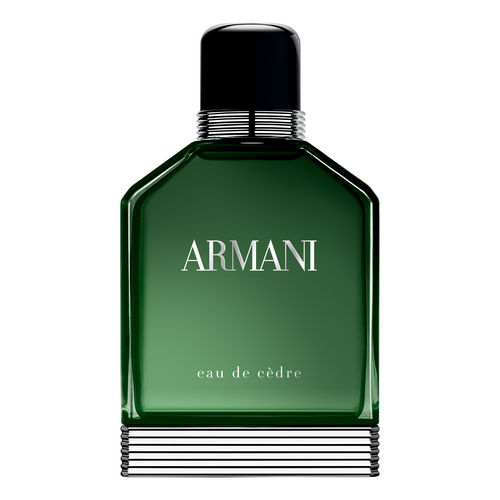
Giorgio Armani’s 2015 green cedar, tea and suede eau de toilette by Mathilde Bijaoui, inspired by a velvet jacket.
At a glance
Armani Eau de Cèdre is a Giorgio Armani eau de toilette launched in 2015 and credited to Mathilde Bijaoui. It is a green, spiced woody fragrance: violet leaf, bergamot and lemon over cardamom, sage and cumin, on a base of black tea, cedar and suede.
It belongs to a small line of Armani eaux de toilette that Fragrantica groups under Armani Eau pour Homme, the house’s 1984 classic, reissued in 2013.
Creation and context
Fragrantica and Parfumo both date Eau de Cèdre to 2015 and credit Mathilde Bijaoui; FragranceReview gives the same year and perfumer. Fragrantica records its release on 24 August 2015.
According to Fragrantica, it joined a line that already included a 2013 re-edition of Armani Eau pour Homme, Armani Eau de Nuit (2013) and Armani Eau d’Arômes (2014). Fragrantica says each bottle in the line reflects a style of tailoring, and reports that Eau de Cèdre was inspired by the scent of a velvet jacket, “soft, delicate and elegant”, and describes its flacon as dark green glass, a colour chosen for green cedar.
Parfumo credits the bottle design to Rozenn Mainguené. FragranceReview sums up the scent itself as defined by its woodiness, “punctuated by fresh citrus and green notes at the opening, and comforting, spicy tones in the middle”.
Fragrance Help’s original archive entry for Eau de Cèdre noted that it had limited distribution.
The composition
Armani has not published the formula. The structure below uses the materials named by both Fragrantica and Parfumo; the two sources place the sage and violet leaf in different tiers.
Despite the name, cedar is one of three base notes rather than the whole story. It sits with tea and suede in a soft, dry base, while the violet leaf and cumin give the opening and heart their character. Parfumo classes the result as woody-green; Wikiparfum places it in a leather family with a dry-woods subfamily, which reflects the suede in the base. FragranceReview describes the cumin as “a subtle hint” with “an earthy, slightly hot undertone”, and the finish as “both elegant and rugged”.
Why it matters
Eau de Cèdre is not a landmark, but it shows a different side of Armani from its best-sellers. The house’s commercial weight rests on Acqua di Giò, Code and Sì; the eaux were a smaller, quieter line, each named for a single material or mood and tied, in Fragrantica’s account, to the house’s tailoring.
It is also a good example of cedar used as a supporting material rather than a showpiece. Here it is paired with black tea and suede to make a soft base under a green, spicy top, closer to the texture of cloth than to raw wood, which fits the velvet-jacket brief that Fragrantica describes.
The comparison with its siblings is instructive. Eau de Nuit and Eau d’Arômes use the same format with different materials, so the line works as a small study in how one house varies a theme.
Reformulation and editions
Eau de Cèdre was issued as an eau de toilette. No reformulation is documented.
Its current status is unclear. Fragrantica describes it as officially discontinued but still available in some markets, particularly Germany; Parfumo lists it as still marketed by L’Oréal. Check a current retailer in your country before assuming either way, and expect older bottles on the secondary market.
Wearing it today
Expect a green, citrus-leafy opening, a warm cardamom and cumin heart, and a soft tea, cedar and suede drydown. It is refined rather than loud, so it suits the office, daytime and smart-casual settings; FragranceReview recommends it for spring and autumn.
Sample it on skin before buying, because the cumin is noticeable and divides opinion; one Parfumo reviewer found the opening acrid, while another called it “a very beautiful, calming tea like scent”. If you like it, sample Eau de Nuit and Eau d’Arômes beside it.