
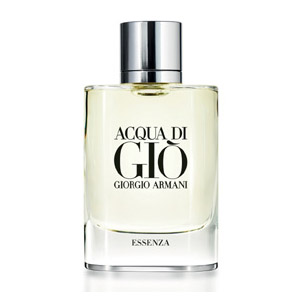
Alberto Morillas’s 2012 rewrite of his own Acqua di Giò: less sea, more herbs, woods and a dry mineral base.
At a glance
Acqua di Giò Essenza is a Giorgio Armani eau de parfum launched in 2012 and credited to Alberto Morillas. It keeps the citrus-and-water idea of the 1996 Acqua di Giò but pushes it toward herbs, woods and a mineral, ambery base.
It has since been discontinued, and it is now sought mainly by collectors and by fans of the original who want a deeper version of it.
Creation and context
Fragrantica, Basenotes and Perfume Posse all date Essenza to 2012 and credit Morillas, who had composed the original Acqua di Giò pour Homme at Firmenich sixteen years earlier. Essenza therefore reads as the author’s own revision of the 1996 structure rather than a new fragrance wearing a familiar name.
Armani positioned it as a more intense reinterpretation of the original. Fragrantica’s launch description says it is “less focused on marine and more on woody and ambery accords”, and Basenotes describes it as a stronger, greener take intended to feel more mature.
The technical changes are specific. Both Fragrantica and Basenotes name two newer Firmenich materials in the formula: Cascalone, a marine note that Fragrantica describes as capturing “cold and fresh water”, and Paradisone, which Fragrantica calls an “explosive” floral molecule. Basenotes presents them as replacements for the Calone and Hedione of the 1996 formula.
Fragrance Help’s original archive entry for Essenza noted that it had limited distribution.
The composition
Armani has not published the formula. The structure below uses the materials named by both Fragrantica and Basenotes.
Fragrantica’s pyramid also lists jasmine, pepper, cedar and ambergris. The effect is a slightly salty woody aromatic in which the sea is present but no longer the subject. Perfume Posse’s reviewer found “a definite salty twist to the citrus/melon” in the opening, followed by herbs, pepper and “wet wood” in the drydown.
Why it matters
Essenza matters mainly as an early attempt by the original perfumer to move Acqua di Giò on. By 2012 the original had been imitated so widely that its fresh, marine signature had become a category rather than a point of difference. Essenza tried to keep the recognisable citrus-and-water outline while giving it the weight and woodiness of an eau de parfum.
It also shows how aquatic perfumery changed after the 1990s. The first marine fragrances depended on Calone; by the 2010s Firmenich had newer water and floral materials, and Morillas used them here to rewrite his own formula. Profumo, three years later, again set a darker base under the familiar top.
Its reception was mixed. Basenotes reports that some wearers notice a sulphurous, metallic facet, and it calls Essenza commercially unsuccessful despite the devoted following it gained after it left the market.
Reformulation and editions
Essenza was issued as an eau de parfum. Fragrantica and Basenotes both list it as discontinued, and neither records a reformulation during its life. Its closest successor is Acqua di Giò Profumo (2015), another Morillas composition that took the line further toward incense and patchouli; Basenotes describes Profumo as the more successful of the two.
The wider Acqua di Giò family has kept growing since, with later versions such as Absolu, Profondo and a Parfum. Each is its own composition, so treat Essenza as a separate fragrance rather than a stronger concentration of the original.
Wearing it today
Expect bright grapefruit and bergamot over a cool watery note, a herbal heart of basil and sage, and a dry, woody-mineral base. Perfume Posse’s reviewer reported about five hours from a dab and more than seven from a spray, so two or three sprays are enough.
Because it is discontinued, bottles now come from the secondary market. Buy from reputable sellers, check the batch code, and sample first if you can: if you like the original but want more depth, Essenza is worth tracking down; if you want the full marine effect, stay with the 1996 original.