
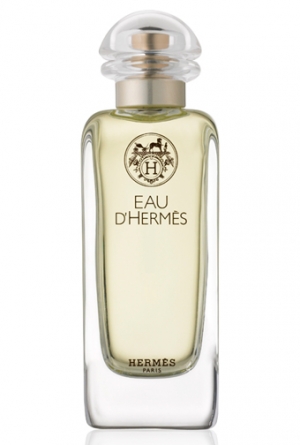
The first Hermès fragrance: Edmond Roudnitska’s spiced leather cologne of 1951, built on the smell of a Hermès bag.
At a glance
Eau d’Hermès is the first Hermès fragrance, composed by Edmond Roudnitska and launched in 1951. It is a spiced leather built on a cologne frame: bergamot, lemon and lavender over cumin, cinnamon and cardamom, with birch, woods and moss in the base.
It is also one of the most polarizing classics in perfumery. The cumin gives it a skin-like, faintly sweaty warmth that some wearers love and others cannot get past.
Creation and context
Hermès was founded as a harness and saddlery workshop in Paris in 1837 and built its identity on leather. It came to fragrance late. Eau d’Hermès, in 1951, was its first perfume, and the house released sparingly for decades afterwards: Calèche followed only in 1961.
Roudnitska was by then working independently through Art et Parfum, the composition house he had founded in 1946 so that he could choose his clients. He had already made Rochas Femme (1944). His best-known work was still to come: Diorissimo (1956) and Eau Sauvage (1966) for Dior.
His brief for Hermès, as he described it, was “the interior of a Hermès bag in which wafted the aroma of a perfume”: a note of fine leather wrapped in a slightly spicy citrus. The quotation is repeated across the fragrance references, and it is an unusually exact description of the result. Roudnitska later wrote at length on the aesthetics of perfume, and his preference for clarity over ornament is already audible here.
The composition
Hermès has not published the formula. The structure below keeps to the materials named in at least two of the standard references.
The effect is less a leather perfume than a cologne worn next to leather. The citrus and lavender arrive first, the cumin almost at once, and the birch-tar leather only gradually. The moss and labdanum give the drydown its dry, slightly animalic finish.
Why it matters
Eau d’Hermès fixed the relationship between Hermès and fragrance at the start: leather, restraint and a cologne structure rather than the heavy florals and chypres of the period. The house has returned to that idea repeatedly, from Bel Ami (1986) to the leather and citrus compositions of the Ellena years.
It is also an early example of Roudnitska’s method: a small number of materials, one clear idea, and an unexpected note placed where it cannot be ignored. The cumin is deliberate, and it anticipates the use of spice as a skin effect in later fragrances. ÇaFleureBon has argued that it paved the way for Jean-Claude Ellena’s Déclaration for Cartier, another fragrance built around cumin.
For anyone studying mid-century perfumery it is a useful counterweight to the period’s aldehydic florals: fresh where they were rich, dry where they were powdery, and frankly bodily in a way few prestige fragrances of the 1950s attempted.
Reformulation and editions
Eau d’Hermès has remained in production as an eau de toilette, in reformulated form. Oakmoss and treemoss, the usual sources of a moss note, have been progressively restricted under IFRA standards since 2008, so expect current bottles to differ from vintage ones, most of all in the drydown.
An essay at culturedarm.com records that Hermès issued commemorative limited editions in hand-etched crystal bottles between 1993 and 2002. Hermès has not published details of reformulation.
Wearing it today
Test it on skin before buying. Expect lemon, bergamot and lavender for the first minutes, then cumin and cinnamon, and a dry, soft leather that stays close. Wear it lightly: two sprays are plenty, and it works best in warm weather and daytime settings, where the citrus holds up.
If the cumin is too much, the later Hermès citrus colognes are the gentler route into the house. If you like it, try it beside Roudnitska’s Eau Sauvage (1966) to hear how his idea of a fresh fragrance developed over fifteen years.
Comments
One response to “Eau d’Hermès: Fragrance Profile”
[…] Eau D’Hermes […]