
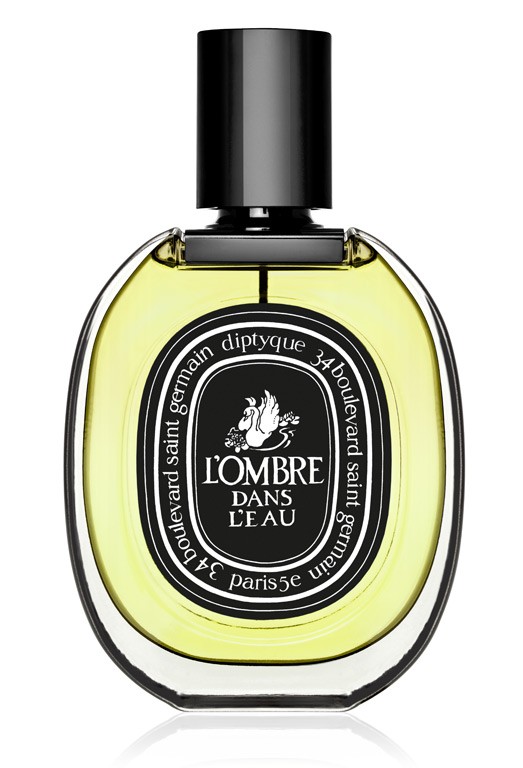
Diptyque’s green rose of 1983, by Serge Kalouguine: blackcurrant leaf against rose, and one of the house’s defining fragrances.
At a glance
L’Ombre dans l’Eau is a Diptyque fragrance composed by Serge Kalouguine and launched in 1983. It is a green floral built on one contrast: the tart, leafy smell of blackcurrant leaf (cassis) set against rose.
The name means “the shadow in the water”, and the fragrance is meant to evoke a green garden at the water’s edge. It is still in production, and it has become one of the house’s defining scents.
Creation and context
Diptyque was founded in Paris in 1961 by Desmond Knox-Leet, Christiane Gautrot and Yves Coueslant as a design shop. Its first eau de toilette, L’Eau, followed in 1968. L’Ombre dans l’Eau came fifteen years later, when the house was still small and independent, and it was composed by Serge Kalouguine; Fragrantica, Now Smell This and CaFleureBon all credit him.
Now Smell This quotes Diptyque’s own description of the fragrance as the scent of a green riverside garden, and CaFleureBon gives the same reading of the name: a garden at the edge of the water, not an aquatic fragrance. The water in the title is setting, not a note.
Fragrantica calls the pairing at its centre an unusual harmony. L’Ombre dans l’Eau puts the rose beside the sharp, almost sour green of crushed blackcurrant leaves, so that the plant is as present as the flower, and The Perfume Society describes the effect as a walk in an English garden.
The composition
Diptyque has not published the formula. Every reference names the same two materials at the centre; the others below appear in at least two sources.
The effect is often described as photorealistic. Reviewers on Fragrantica compare it to crushed stems and wet foliage, and some mention tomato leaf; Now Smell This describes crushed leaves and broken stems with the rose held at a distance, “wafting over from next door”. The greenness is strongest at the start and softens as the rose comes forward.
Why it matters
L’Ombre dans l’Eau is one of the fragrances on which Diptyque’s reputation in perfume rests, as distinct from its candles. Fragrantica counts it among the house’s classics, and CaFleureBon describes it as a modern classic. It also shows the literal, subject-led approach Diptyque is known for: a specific place or plant, rendered as directly as possible.
It shows, too, how much a fragrance can do with two materials. Now Smell This’s reviewer calls it one of her favourite rose fragrances, and Fragrantica’s reviewers describe it as photorealistic: its reputation rests on how convincingly it reproduces a real, green garden rather than an idealised flower.
Samuel Sayre has described L’Ombre dans l’Eau as unique and exotic, and it remains a good introduction to how a single, unusual pairing can carry an entire fragrance.
Reformulation and editions
The original is an eau de toilette. An eau de parfum followed in 2012, also credited to Kalouguine by Fragrantica and Luckyscent. Fragrantica reviewers describe the eau de parfum as denser and sharper, and the eau de toilette as more watery and translucent.
Diptyque has not published a reformulation history. The fragrance is sold today in both concentrations, and the two are different enough to be worth sampling separately.
Wearing it today
Expect a sharp, leafy green opening, a cool rose that grows clearer over the first hour, and a soft, close finish. It suits spring and early summer and daytime wear.
If you find the opening harsh, give it ten minutes: the greenness settles and the rose becomes easier to hear. If you want more presence, try the eau de parfum; if you want the lighter, more transparent version, stay with the eau de toilette.
Comments
2 responses to “Diptyque L’Ombre dans L’Eau”
[…] L’Ombre Dans L’Eau […]
[…] L’ombre Dans L’eau […]