
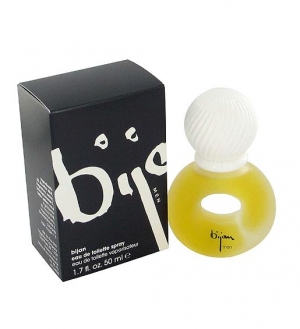
The Rodeo Drive designer’s spiced oriental fougère, winner of a 1988 FiFi Award and sold in one of the best-known bottles of the decade.
At a glance
Bijan Men is the signature fragrance of the Beverly Hills designer Bijan Pakzad. Its wide release came in 1987 with the launch of the Bijan fragrance division, and in 1988 it won the Fragrance Foundation’s FiFi Award for Most Successful Men’s Fragrance (Exclusive). It is a spiced oriental fougère: lavender, rosemary and citrus over nutmeg and woods, with an amber, musk and oakmoss base.
Its ring-shaped glass bottle is one of the best-known flacons of the decade, and the fragrance is still in production.
Creation and context
Bijan Pakzad, an Iranian-born designer, opened his by-appointment menswear boutique at 443 North Rodeo Drive in 1976. It built a reputation as one of the most expensive shops in the world, dressing politicians and film stars. Fragrance was a natural extension of that image of expensive, conspicuous luxury.
The dating needs care. Bijan’s own history gives 1987 for the launch of the fragrance division, and Fragrantica and Now Smell This date Bijan Men to 1987. Basenotes lists Bijan for Men under 1981, and Fragrantica notes an earlier presentation, which it dates to 1981 in its database and to 1979 in a later feature. The most likely reading is an earlier boutique fragrance followed by the 1987 wide release; the two may or may not share a formula.
Fragrantica and the perfumer directory Silloria both credit the composition to Claudette Belnavis. Bijan died in 2011, and the fragrance business has continued under the Bijan name.
The composition
Bijan has not published the formula, and the full note lists run to thirty or more materials. The structure below names only those that appear in at least two of the references (Fragrantica, Now Smell This and Basenotes).
This is a classic 1980s structure: a barbershop lavender-and-herb opening, a spiced heart and a heavy amber-moss base, all at high strength. Now Smell This describes a “spicy-floral blend of fresh lemon and bergamot spiked with balmy nutmeg”, and Basenotes reviewers speak of a “golden glow” and a loud opening that settles into something smoother.
Why it matters
Bijan Men is a landmark of the 1980s luxury men’s fragrance: dense, long-lasting and sold as a status object as much as a scent. Fragrantica reports that Bijan’s fragrances ranked among the best-selling in American department stores in the late 1980s, and the brand’s own history calls them the top seller in many department stores internationally. The success carried into the next decade: Bijan launched the Michael Jordan fragrance in 1996 and won two more FiFi Awards in 1997, including Men’s Fragrance Star of the Year.
The bottle is part of its place in history. The circular glass flacon has an open centre, and a dividing web inside the ring means that, half full, the liquid sits in two separate chambers. Bijan also took the 1988 FiFi for Best Women’s Fragrance Package, and an example of the ring bottle is on permanent display at the Smithsonian Institution.
Reformulation and editions
Bijan Men is sold today as an eau de toilette; Basenotes notes that current bottles use a newer “b”-shaped design. Bijan has not published a reformulation history, but reviewers on Fragrantica and Basenotes agree that current bottles are thinner and less diffusive than vintage ones.
Oakmoss, one of its base materials, has been restricted under IFRA standards since 2008, which may account for part of the difference.
Wearing it today
Expect a sharp lavender-and-citrus opening, a warm nutmeg heart and a long amber-and-moss drydown with strong projection. It suits cool weather and formal settings, and it reads as unmistakably 1980s.
Use one spray, two at most. If you can find a vintage bottle, compare it with a current one: the difference in depth shows how much this kind of fragrance depended on materials that are now restricted.
Comments
One response to “Bijan Fragrance Profile and 1988 FiFi Award”
[…] Bijan […]