
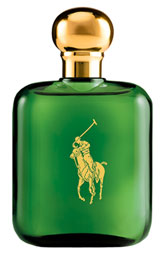
One of Ralph Lauren’s first two fragrances: a dense pine-and-oakmoss chypre by Carlos Benaïm, launched in 1978 and known as Polo Green.
At a glance
Polo is one of the first two fragrances from Ralph Lauren, launched in 1978 and composed by Carlos Benaïm of IFF. It is a dense, woody chypre of pine, juniper and herbs over oakmoss, patchouli, leather and tobacco.
It is widely called Polo Green after the colour of its bottle and packaging, which separates it from later fragrances in the line such as Polo Blue and Polo Red. It won a FiFi award in 1979 and is still sold.
Creation and context
Ralph Lauren entered fragrance almost ten years after founding his clothing business. According to InsideHook, he was courted by Estée Lauder but chose a partnership with Warner Communications, and the Warner-Lauren venture launched Polo and Lauren in the same year, 1978.
Carlos Benaïm of IFF is credited with Polo by Wikipedia and by Fragrantica. The fragrance was meant to carry the image of the clothes, and Lauren’s own description of his approach, quoted by Fragrantica, fits it: “I am not a fashion person. I am anti-fashion. I am interested in longevity, timelessness, style.” The green bottle with a gold polo player and gold cap has been recognisable since the launch.
The production history falls into three eras, which collectors still use to date bottles. Warner made Polo from 1978 to 1984; it then sold its cosmetics business to Cosmair, the American arm of L’Oréal, which made Polo until about 2000; since then it has been made within L’Oréal. The Ralph Lauren house entry sets out the business side in more detail.
The composition
Ralph Lauren has not published the formula. The structure below uses only the materials named in at least two of the standard references.
The pine and the moss carry the structure. Pine gives Polo its immediate green signature, the herbs and cumin add a rough, skin-like edge, and the oakmoss, patchouli and leather make it a chypre rather than a simple aromatic. Fragrantica classes it as a woody chypre; the house entry describes it as an aromatic close in structure to a chypre. Either way, it is built for strength rather than transparency.
Why it matters
Polo set the template for the American designer fragrance. It showed that a fashion brand could launch a serious, uncompromising fragrance and sell it on the image of the clothes, and its paired launch with Lauren helped make a paired debut standard practice for designer houses.
It is also one of the defining green fragrances of the late 1970s and early 1980s, alongside the aromatic fougères of the same years. Its name still anchors Ralph Lauren’s largest fragrance family, and every later Polo fragrance is defined in relation to it.
Reformulation and editions
Polo has been reformulated more than once. InsideHook attributes the main change to the industry’s restriction of oakmoss, a central chypre material, whose permitted level was cut sharply from the early 2000s; the IFRA restrictions from 2008 went further. Fragrantica reviewers consistently describe the current version as lighter and less mossy than Warner-era and Cosmair-era bottles, and Fragrantica’s fortieth-anniversary review singles out a 1993 Cosmair bottle for its green strength and lasting power.
The original remains in the line as an eau de toilette. Many other fragrances have followed under the Polo name. A recent addition, Polo Est. 67 (2024), is a new fresh, sporty composition rather than a version of the original.
Wearing it today
Expect a sharp, herbal, pine-green opening, a resinous heart and a long, dark drydown of moss, leather and tobacco. It projects strongly: one or two sprays are enough, and it suits cool weather and evenings better than a hot office.
If you want to hear what the original sounded like, look for older Warner or Cosmair bottles, and check the condition of the juice before buying. Comparing a vintage and a current bottle side by side is the clearest way to hear how oakmoss restrictions changed the chypre.